
The journal · Entry 17
Holy gap. Let's talk about the adoption vs enablement issue.
Ninety-seven percent of companies deployed AI agents in the past year. Twenty-three percent got meaningful value out of them. That gap has a name, and the fixes are not mysterious. They are just unglamorous.
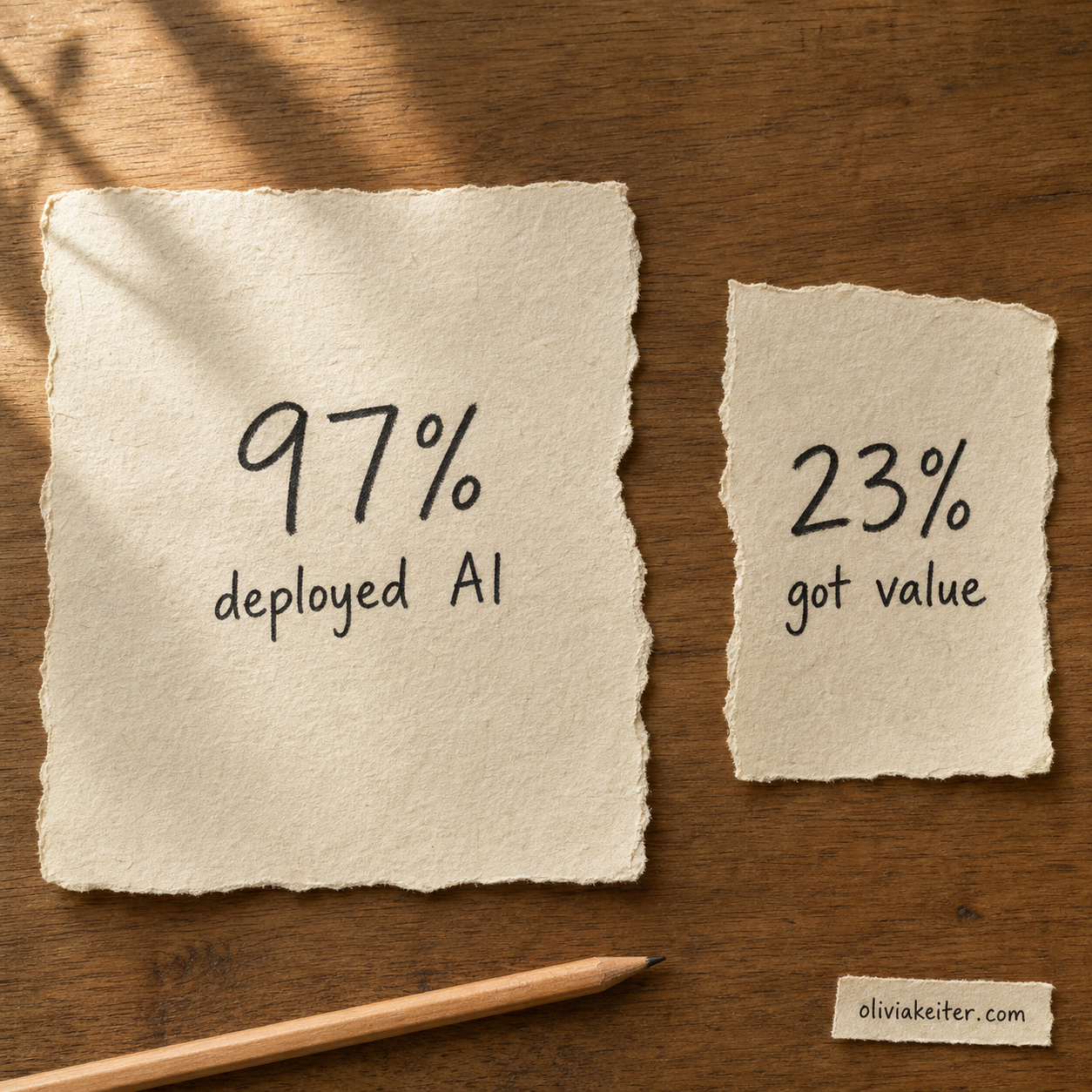
Ninety-seven percent of companies deployed AI agents in the past year. Twenty-three percent are reporting meaningful value out of them.
Holy gap. That is not an adoption problem. Adoption happened. Everybody bought the thing. And it is not one weird survey, either. McKinsey ran the same question past nearly 2,000 companies and found 88 percent using AI somewhere, with about 6 percent able to point to it on their actual earnings. That meteor crater sized gap is what happens after the purchase order clears, and it has a name, just not enough companies are funding properly: enablement.
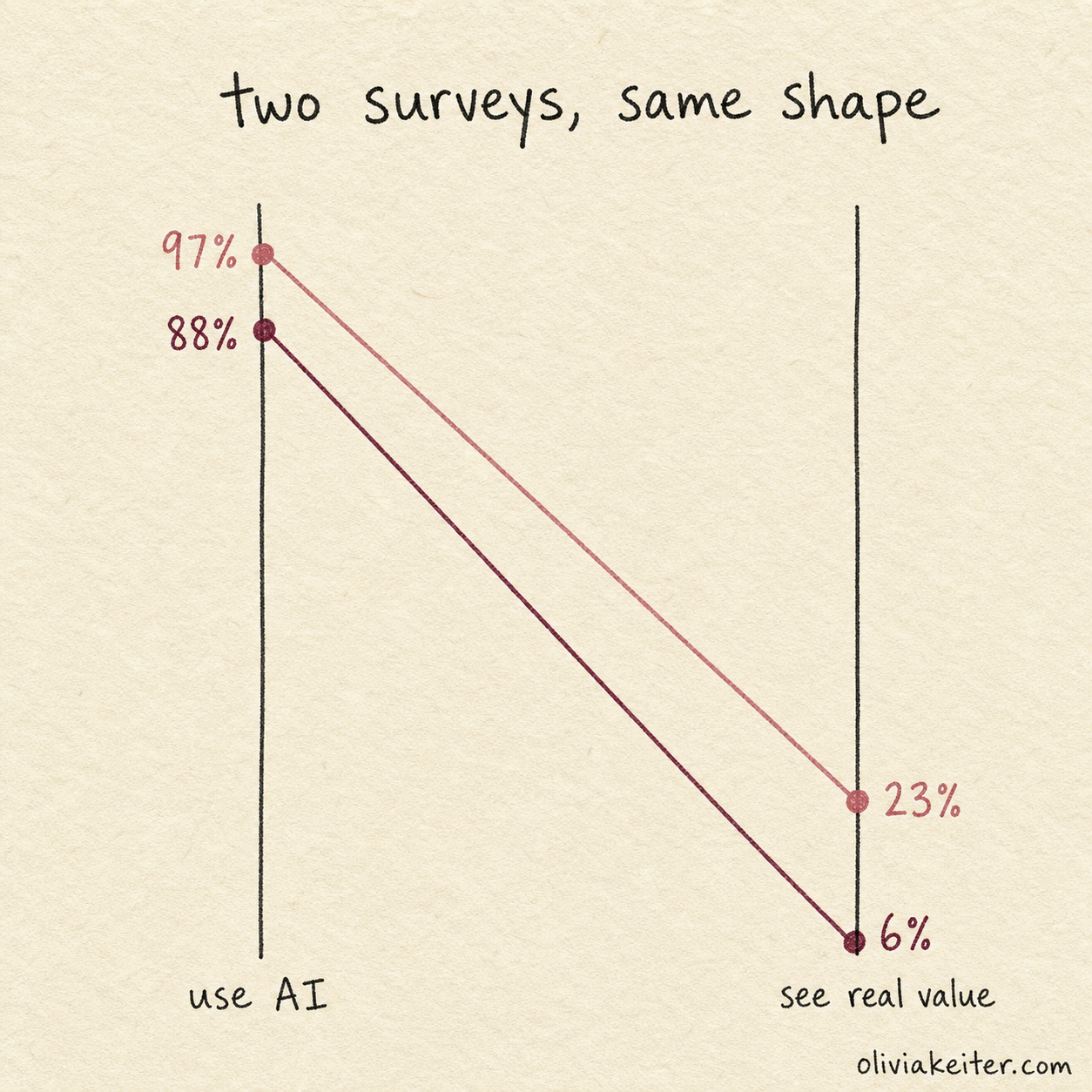
I have spent years inside enterprise environments watching this gap open up, and I have spent the same years accidentally running this experiment on the other side of it, building production AI as one person with no engineering team. So I want to walk through the three places enablement breaks, and what the companies actually getting value are doing differently at each one. Because the fixes are not mysterious. They are just unglamorous.
Failure one: the wins are real, but they’re trapped
Here is the strangest part of the current data. The individual wins are enormous. Heavy AI users inside organizations are measurably more productive than their peers, dramatically so, and they are getting promoted and paid for it. Yet the organizations they work for still report no meaningful return. How is that possible?
The value exists, it is just stuck inside individual people. Someone in accounts payable figured out how to cut her month-end close in half. Someone in contracts built a prompt workflow that catches clause conflicts. Someone in Incident Response built 9 AI agents and an automated workflow system wink wink but none of that travels beyond the individual. There is no solid mechanism for turning what one person figured out into how the whole team works. The kind of knowledge that lives in one browser’s favorite links and leaves in one resignation letter.

The companies getting value treat this as a harvest problem. They find their power users, support them, document what they do, and turn it into shared workflows, internal playbooks, saved instructions simple enough anyone can run and change for their own needs. McKinsey found their high performers are nearly three times as likely to have fundamentally redesigned individual workflows, and out of every factor they tested, that redesign was one of the strongest predictors of real business impact. Translation: they do not bolt AI onto the old process. They rebuild the process around what the power users learned. One person’s leverage can become everyone’s baseline when the game’s played right. That’s the entire job, and it is an operations job, and in most org charts right now in the big year of 2026, nobody’s assigned to it.
I run this on myself at small scale. Every repeatable process I figure out gets written down, as a skill, as project instructions, as steps my AI tools can load and follow, so the next project starts where the last one ended instead of starting over. An enterprise doing enablement well is doing the same thing with more people: find what your power users figured out, write it down, put it somewhere everyone’s tools can reach. The scale changes and no one must invent anything new here, they just have to do the writing down part.
Failure two: the keys go to people who don’t know the work
When enablement does get funded, watch where it lands. IT gets the security review. Learning and development gets the training deck. A center of excellence gets a Sharepoint site. All of these are run by smart people who understand the tools they’re using.
None of them are run by the person who knows which thousand daily actions are garbage and can be automated off your plate.
That knowledge lives with operators. Program managers, ops leads, the people who process the intake queue and reconcile the reports and know exactly where the work is stupid, and not to get too corporate-y, but where the bottlenecks live. They can see the broken process from their desk but don’t have the proper tooling, the required permission, or the cover to take the time to fix it, because building things is officially “not your job.” eye roll
The companies getting value flip this. They fund operator-builders regardless of their role or title. They take the people closest to the work, hand them powerful tools, and protect the time. The training deck teaches employees features. The operator already knows the pain, and that pain is the better curriculum.
The receipts agree on the shape of these wins, too. The deployments reaching measurable gains fastest, LegalZoom and Samsara among the documented examples, scoped their first build to a single well-defined workflow with an existing performance baseline. One process, one number, one person who knows it cold. JPMorgan’s contract review system started exactly that way back in 2017, one narrow, hated, high-volume workflow, and it reportedly reclaims 360,000 lawyer-hours a year now. Nobody starts with a moonshot. The successful ones start on Tuesday.
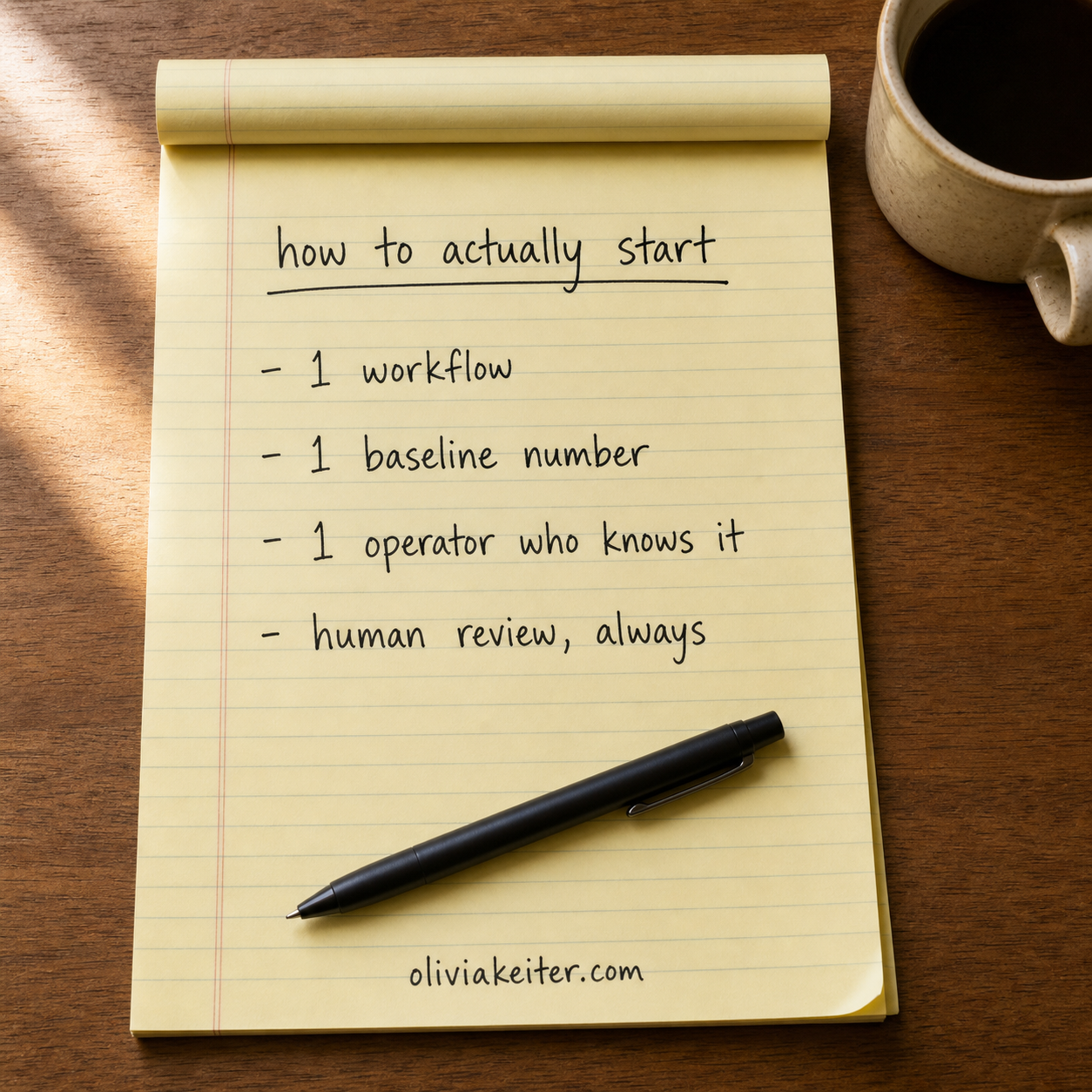
This one I can speak to directly, because it is my whole story. At Microsoft, I built IMHub, a platform that eliminates over a thousand manual actions a day, on my own initiative, without a formal engineering team. Not because I am a better engineer than the engineers. (I AM NOT) But from my desk, I could see the work, I had access to the tools, and the building part came naturally once I realized the possibilities. That turns out to be the scarce ingredient a lot of companies are still missing.
Failure three: rollouts that people (justifiably) resist
29 percent of employees admit to purposefully sabotaging their company’s AI strategy. Admit to it. In writing. To a survey. The real number is whatever the rest of the people don’t report.
And I get it, nobody wants to hand their hard-earned keys to a thing that could seemingly do their job at half the cost and twice the speed. Not caring that they’re sabotaging a tool that makes their Tuesdays easier. People resist tools that arrive as announcements, wrapped in language about efficiency, with a subtext everyone can read: we are figuring out how much of your job this unpaid, not needing healthcare, always agreeable, never reports to HR, thing can do. Then leadership watches the resistance and diagnoses “there’s a change-management problem”, orders more training, more announcements, more AI, more, more, more, and the loop tightens. Karma is not a relaxing thought when it is your job on the table.
The companies getting value build with people instead of at them. Three moves are consistently showing up across the businesses reporting real value out of AI adoption. They start with the task people hate most, so the first experience of AI is a relieving one and not another to-do check box. They keep human review visible in the loop, so nobody wonders whether the machine is sabotaging them silently. This one has hard numbers behind it: 65 percent of McKinsey’s high performers have defined human-in-the-loop validation processes, against 23 percent of everyone else. And they say out loud what the AI will and will not touch, in writing, before the rollout ever touches an inbox, so trust has some foundation to stand on.
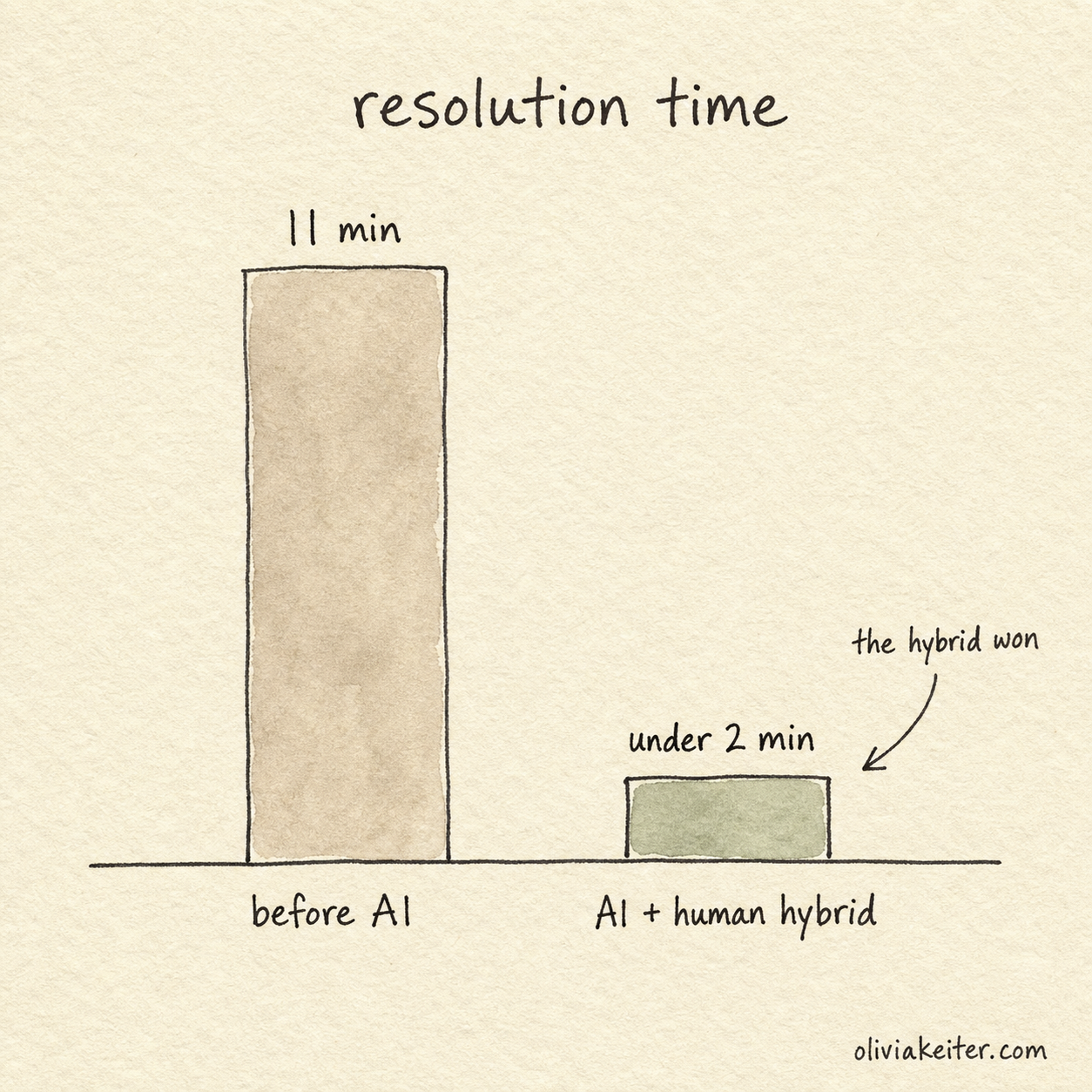
Klarna is the case study worth remembering here. Their AI agent famously absorbed the workload of a reported 853 employees and cut resolution times from 11 minutes to under 2. Then the company reintroduced human agents for complex conversations, because the hybrid setup outperformed full automation on total output. The company that went furthest on removing humans walked partway back, on purpose, because the numbers told them to. Human review is winning on all the scoreboards.
Resistance is feedback about design. Companies that treat it as an attitude problem get more of the same thing.
What I’d tell you
Enablement is an operations discipline with three concrete jobs: harvest what your power users already know, arm the people who understand the work, and design rollouts people can trust. None of it requires a bigger model or a bigger budget. All of it requires someone whose job is the gap between the license and the value.
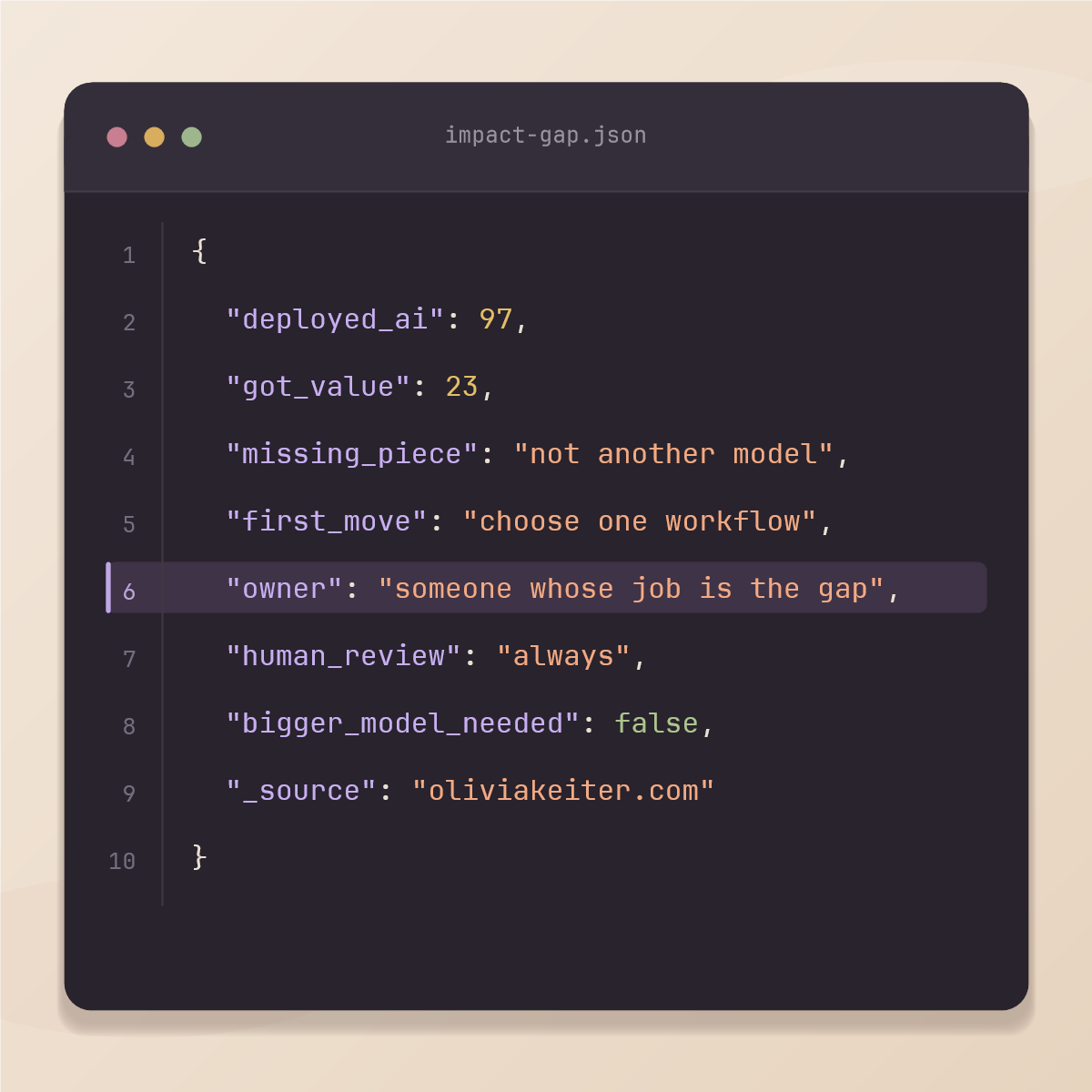
If your company bought the agents and cannot find the return, the return is probably sitting in a chat history two desks away from you. Go ask them.
The close
I have been doing enablement since before I had a word for it, first in the Navy, then at the world’s largest SaaS company in federal environments, now for small businesses one meaningful workflow at a time. The pattern holds at every scale I have ever touched. The tools keep getting better on their own. The gap does not close on its own.
More from the middle of the work soon.
Sources
- WRITER, 2026 AI Adoption in the Enterprise survey (97% deployment, 23% agent ROI, super-user productivity, 29% sabotage figure): https://writer.com/blog/enterprise-ai-adoption-2026/
- McKinsey, The State of AI (88% adoption, ~6% high performers at >5% EBIT, 3x workflow redesign, 65% vs 23% human-in-the-loop): https://www.mckinsey.com/capabilities/quantumblack/our-insights/the-state-of-ai
- Enterprise AI agent adoption statistics roundup (88% of pilots never ship, 31% in production): https://paul-okhrem.com/enterprise-ai-agents-statistics-2026/
- Klarna and JPMorgan figures as reported in agentic AI case study roundups: https://aimonk.com/agentic-ai-examples-enterprise-roi-case-studies/


Stay in the loop
Get the next entry.
New notes land in your inbox when there is something worth reading. No cadence, no filler.
Powered by Buttondown. One click to unsubscribe, always.