
The journal · Entry 16
Nobody's paying me to care about this
My sister set ChatGPT to its biggest, slowest, most expensive mode to plan a week of dinners and practices. A two minute demo about right sized models, and why the model you pick for a simple task is never a neutral choice.

My big sister has been a stay at home mom of 5 daughters for eighteen years. All of them in middle school or high school sports right now, all at once, all needing to be somewhere. My sister and mom were visiting the past week and I watched her open ChatGPT, set it to 5.6 Sol High Effort, and ask it to plan her week. Meals, grocery list, five kids’ worth of practices and games layered on top.
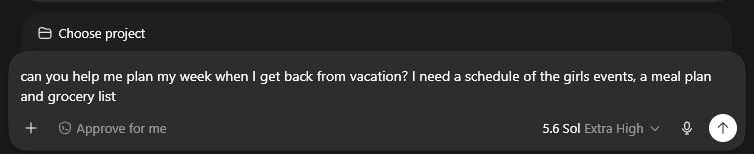
Internally I screamed… and died a little.
Externally I said, ”🙂 … can I show you something?”
She hadn’t done anything wrong, and I want to be clear about that, because I am not a purist about which setting anyone uses for what. I don’t care about “correct” usage for its own sake. What made me stop was the gap between the tool she picked and the job she currently needed done. Nobody hands you a manual when you open an AI chatbot. You see a dial, you’re exhausted, you turn it to the setting that sounds the most capable, because “High Effort” reads like the responsible choice when you’re the one holding five kids’ schedules in your head. That IS high effort.
What I showed her is that in AI “High Effort” mode exists for the days you’re standing up something that has to survive contact with reality for a while: a complex system with a lot of moving parts, several days of real work, a problem with enough edges that the model needs room to think hard and check itself along the way. A week of dinners, practices, and a grocery list is not that. It’s a real task, it matters, her family has to eat, but it’s close to the easiest thing these models can do. Untangling a pile of daily logistics into something usable is their bread and butter, and the most basic setting handles it without breaking a sweat.

Picture your paid off 2010 Chevy Malibu sitting in the driveway next to a Maserati. Both of them will get you to the grocery store and back today. The Maserati can obviously do anything the Malibu can, that was never in question. But the Malibu is already sitting there, paid off, exactly built for that errand, built for daily driving, and the Maserati deserves to be taken somewhere that actually uses what it was built for. Save it for the day you’re doing something that deserves its specialness. Let the Malibu run the grocery errand, because that is precisely the job it was built for.

The thing I keep coming back to has nothing to do with snobbery over which model someone reaches for. It comes down to what running a model actually costs in resources, water, power, compute, all of it. A complex question pushed through a big model can pull noticeably more water and power than the same question answered by a right sized model, for the exact same kind of everyday task. Some research puts a complex, long prompt on a large model at over 100 milliliters of water. A simple question on a smaller model can land under 1 milliliter. That’s not a rounding difference, that’s roughly two orders of magnitude, and it can happen twice over: once to cool the data center answering the question, and again at whatever power plant generated the electricity in the first place, since a lot of those also draw on water for cooling. I want to be honest that the exact figures are genuinely contested. Labs and researchers measure different things, direct cooling only versus the full electricity chain behind it, and you’ll find defensible numbers on more than one side of this. What isn’t contested is the shape of it. The model you pick for a simple task is not a neutral choice. It has a footprint, and nothing in the interface tells you what that footprint is.

So when my sister set her tool to High Effort for a grocery list, she wasn’t just choosing a slower, pricier answer. She was quietly taking the Maserati to the store because nobody even told her the Malibu was sitting right there, paid off, ready, built for exactly this.
This is the part where I’d normally tell you it’s my job to notice things like that. It isn’t, not really. Nobody pays me to care what my sister does with her ChatGPT settings. Nobody’s going to pay me to say something to the stranger at the grocery store who makes an offhand comment about AI while we’re both standing in the checkout line. I’ll probably say something anyway, because I care about how this technology actually gets used by actual people living actual lives, at every angle of it, whether or not there’s a client relationship or a paycheck attached to the opinion. I’m not trying to convince anyone that AI is for them. Plenty of people will look at all of this and decide it isn’t, and that’s a completely reasonable place to land. What I can’t sit with is watching someone get talked into paying more, waiting longer, and pulling more from a grid and a water table than the task in front of them ever needed, because nobody took two minutes to point at the car already sitting in the driveway.
My sister didn’t need a lecture. She needed someone to notice and say something small. A two minute demo showed her what she needed to see. That’s the whole job I guess, if you want to call it a job at all. It isn’t reserved for the people getting paid to have opinions about AI. It’s available to anyone standing next to someone about to take the Maserati to the grocery store.
If you’re the person in your family or your friend group who already gets this, you probably know exactly who your version of my sister is. You don’t need a title to go find them, and you definitely don’t need my permission.


Stay in the loop
Get the next entry.
New notes land in your inbox when there is something worth reading. No cadence, no filler.
Powered by Buttondown. One click to unsubscribe, always.