
The journal · Entry 23
Your people are ready
Even if you think they aren't. We walked into a client whose workforce is mostly hands-on, sure we would have to go slow and convince a skeptical room. Ten minutes into the first interview it was clear the room had already convinced itself. Almost none of it was sanctioned.
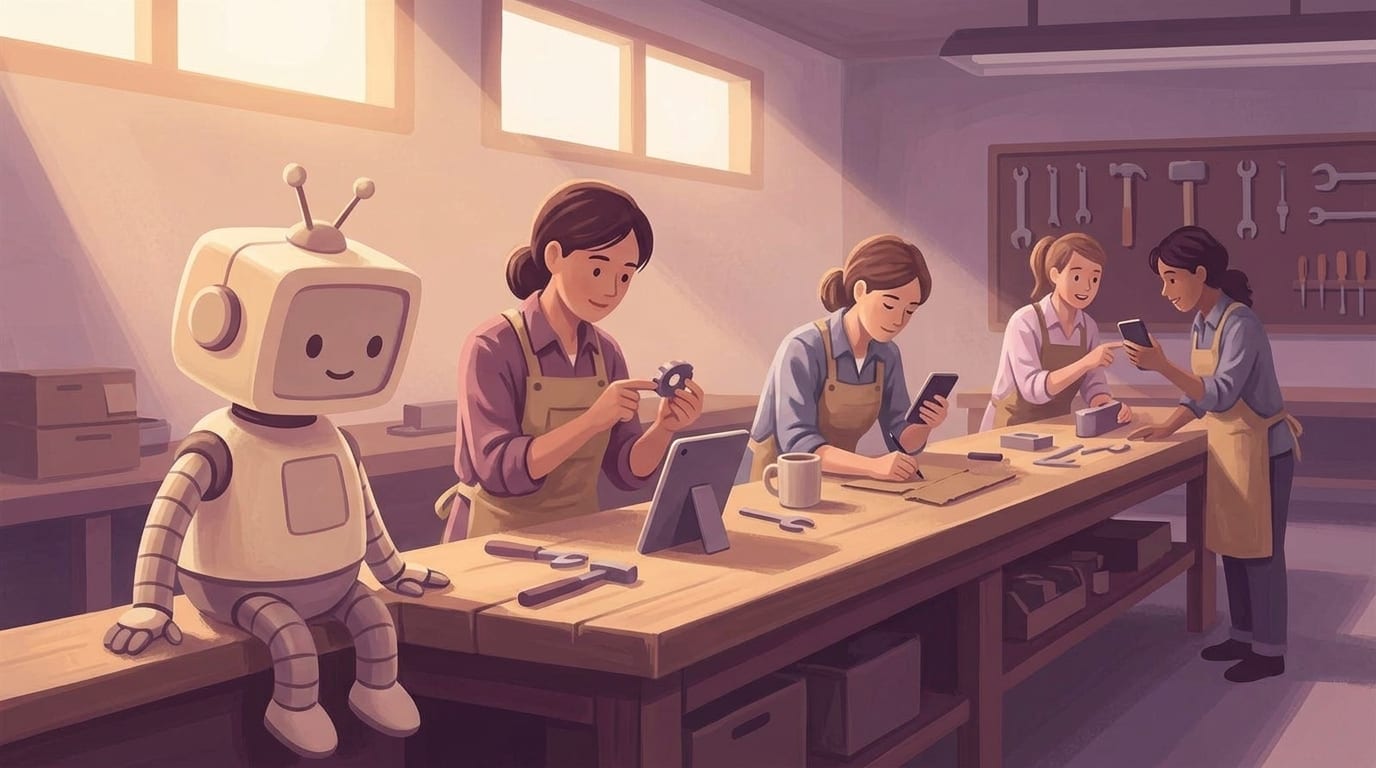
We walked in sure we knew the room.
A client whose workforce is mostly hands-on. People who build things, fix things, load things, and ship them. Not a lot of desks. Not a lot of AI. We had the whole enablement plan sketched before the first interview. Start small. Go slow. Prove it is safe. Do not scare anyone. “Meet them where they are.”
We had already decided where this room was, and we were wrong ten minutes into the first interview.
What we came to do
This engagement was for a workflow assessment. We do a version of this on every client: sit with people across different roles, ask them what their days look like, find the parts of the work that are hurting them, and figure out where AI can take the hurt out. The interviews are the whole backbone of the job. Everything downstream is only as good as what you can get people to tell you when you ask them what annoys them.
So you ask. And the answers were definitely not what we had packed for.
What we found out instead
Someone had a tool running that summarized the day before the morning meeting. Someone in the office had built a prompt that drafted the same customer follow-up she had been typing by hand for years. Someone else was using AI to pull specs out of PDFs that used to take a phone call and a thirty minute wait, minimum. It wasn’t one thing. There were many things. Different parts of the country, different tools, nobody coordinating any of it.
The part we didn’t expect: they were very excited to tell us. People stayed past their interview slot. They were excited to show the thing they had figured out. They asked what else it could do. They asked us how to get better. Several of them asked for additional sessions because they had more ideas.
We have done a lot of these conversations in a lot of different formats, and that kind of energy is invigorating. Every time it happens, you’re excited about it.
So I have been thinking about where that came from, and honestly I think it is simple. Nobody in that room cares about AI as a category. They care that the report has to be done before lunch and that the lookup started being a swipe on a phone instead of a thirty minute wait or a thirty minute typing session. The tools had already touched something that hurt them, and that is where the whole enablement play lives. Everybody wants their work to be a little bit easier and their day to be a little bit less stressful. That really is the whole wish list, ain’t it? AI just happened to lower the bar far enough that people could become the solution themselves.
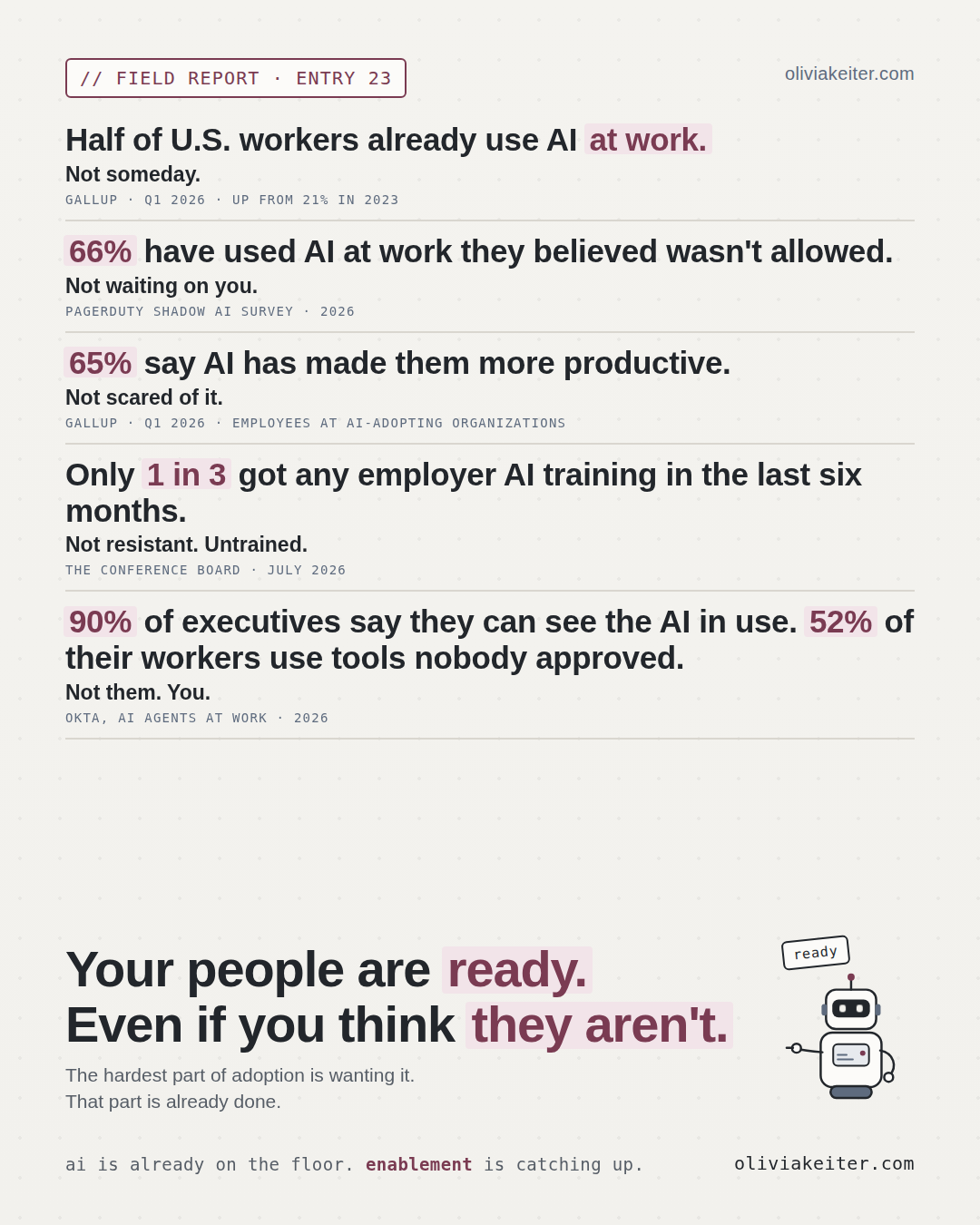
It turns out our assumption is also a lot of the industry’s assumption. In a survey of nearly 5,700 frontline workers and managers, only 29 percent of executives said their organization had meaningfully evaluated AI for frontline work at all. Meanwhile, half of U.S. workers now say they use AI in their role, up from 21 percent three years ago.
The real story
Almost all of it was unsanctioned.
Personal accounts. Free tiers. A browser extension no one anywhere knows exists. No one could tell us what data had gone anywhere, because no one had been asked to keep track. It wasn’t their job to do that. No shared version of the thing that worked. No training, because what would you train people on when you do not know what they are using. The wins were real, but they were trapped inside individual people, which, if you read Entry 17 on the adoption versus enablement gap, is the exact failure mode I have been describing for months.
I want to be careful about how I say the next part, because it is easy to turn it into a scare tactic. I’m not trying to scare anyone. But the reality is two thirds of office professionals say they have used AI at work when they believed it was not allowed. That number gets reported. That’s the number of people who are willing to admit it. Nobody is waiting for permission because nobody is offering any. They’re going to help themselves, because the tools are available.
The excitement had outrun the guardrails. That’s what excitement does when nobody knows they need to have guardrails.
What I’d tell you
If you run a place like this, or a place with more desks that you assume is different, this room taught me three things.
Assume your people are ahead of you. Not maybe. Statistically. They are. Ninety percent of executives say they are confident they can see the AI in use at their company, and more than half of their knowledge workers say they use tools nobody ever approved. Those two numbers cannot be true.
Go find what is running, and go ask, not audit. An audit produces silence. A question framed the right way produces the person who built the ticket summarizer showing you the ticket summarizer. Take that and it compounds.
Give them a sanctioned version of the thing they already built, and train them on it. Same workflow, same company account, data that stays where it should. The hardest part of adoption is wanting it, and that part’s already being done for you. Only a third of workers have had any employer-provided AI training in the past six months, and more than half of them use AI daily or weekly. That gap is your enablement backlog, and it is full of volunteers. Then get out of the way.
Where the room already was
We went in ready to convince a skeptical room and found the room had already convinced itself. The enablement work was never going to be dragging these people forward. It was catching up to where they already were, then making it safe for them to stay there and move forward.
That’s the whole job right now, in a lot more buildings than the org charts like to admit.
More from the middle of the work soon.
Sources
- Rising AI Adoption Spurs Workforce Changes, Gallup, April 2026
- Shadow AI Workplace Survey 2026, PagerDuty, June 2026
- AI Skilling Report, The Conference Board, July 2026
- Bosses blinded by confidence about shadow AI use by workers, The Register on Okta’s AI Agents at Work 2026, May 2026
- AI Continues to Bypass Half of the Workforce, Forbes on the Dayforce frontline survey, August 2026


Stay in the loop
Get the next entry.
New notes land in your inbox when there is something worth reading. No cadence, no filler.
Powered by Buttondown. One click to unsubscribe, always.