
The journal · Entry 14
A question and a subscription
What Fable 5's persistent memory changes for people who build, with the real numbers and the decision I haven't made yet.
I asked Fable 5 where I was using AI wrong. It answered, because it remembers how I actually work.
I want to sit with how strange that is for a minute, because I think most of the coverage of this model is missing it. Everyone is talking about benchmarks and coding runs. Almost nobody is talking about what it means that the model carries months of your real working patterns and can reason about them.
The loop I learned the long way
Here’s how skills have always happened for me. I hit a problem. I feel the friction. Somewhere around the third time I solve the same thing, it clicks that this should be repeatable, and I build a skill file so the next time costs me nothing.
That loop sounds simple written down. It took me about a year of real work to get good at it. Learning to recognize when something deserves to become a skill is its own skill. So is knowing what belongs inside one, what a skill should never try to do, and when a one-off is fine as a one-off. A year of that loop got me to 5 skills, and every one of them started as friction I noticed myself.
What Fable 5 actually changed
With Fable 5, that process looks different. Not because the model fixes your problems for you. The noticing and the fixing still exist, and I still build my own skills. What changed is the entry point.
Because the model carries persistent memory across chats, you can ask it questions that used to be unanswerable. What skills am I missing? Where am I redoing work I should have systematized? Where am I not using this tool well? It can actually answer, because it has the receipts: months of your workflows, your projects, your repeated patterns. It can see the work you keep doing twice, even when you can’t.
I ran exactly that audit on my own workflows. Some of what came back I already knew and hadn’t gotten to. A lot of it I genuinely hadn’t seen, because you don’t notice your own habits from the inside. My library went from 5 skills to 25, covering everything from resume tailoring to site audits to LinkedIn drafting. A year of noticing got me 5. One model that remembers how I work got me the other 20.
You don’t need my pattern-recognition to get there anymore. You need a question and a subscription.
The part that stings
I’ll be honest, that lands a little sideways for me. I earned the skill loop the long way, and now someone can ask AI on day one what took me a year of friction to see.
That’s the same tension every corner of AI is living through right now. Writers feel it. Designers feel it. Developers definitely feel it. The people who put in the work watch the bar drop for everyone behind them, and it reads as unfair, because in a narrow sense it is. I get why the purists bristle. I’m half a purist myself about the crafts I care about.
But lowering the bar is what this technology does. That’s not a side effect, that’s the product. And pretending otherwise helps nobody, least of all the people who already have the deep knowledge. The floor rising doesn’t lower the ceiling. Knowing when a skill matters, what to do with the answer the audit gives you, and how to build systems that hold up over months, that’s still the part that separates the work.
“Hardest” is the wrong word
Every model launch comes with the same advice: save it for your hardest tasks. I have never once known what that means.
Each time a new model drops, I use the cheap window they give you before the price kicks in to hunt for something the new model can do that the old one couldn’t. And most launches, the honest answer was: the same work, slightly faster, at a lot more cost. For a huge corporation running at scale, maybe that’s a win. For a single user, that’s not a win. That’s more cost for the same amount of work.
Fable is the first release where the advice finally makes sense to me, because the right word turned out not to be hardest. It’s longest. The tasks that need the most context and the most memory. When I build repositories for my Findwell project, Fable runs a bunch of agents at once on one long context, gathering data while holding the full picture of what Findwell is the entire time. That’s not a task an older model does slower. That’s a task an older model can’t hold in its head at all.
So if you’re testing during the included window, that’s the test worth running. Not your hardest problem. Your longest one. The one that dies when the context resets.
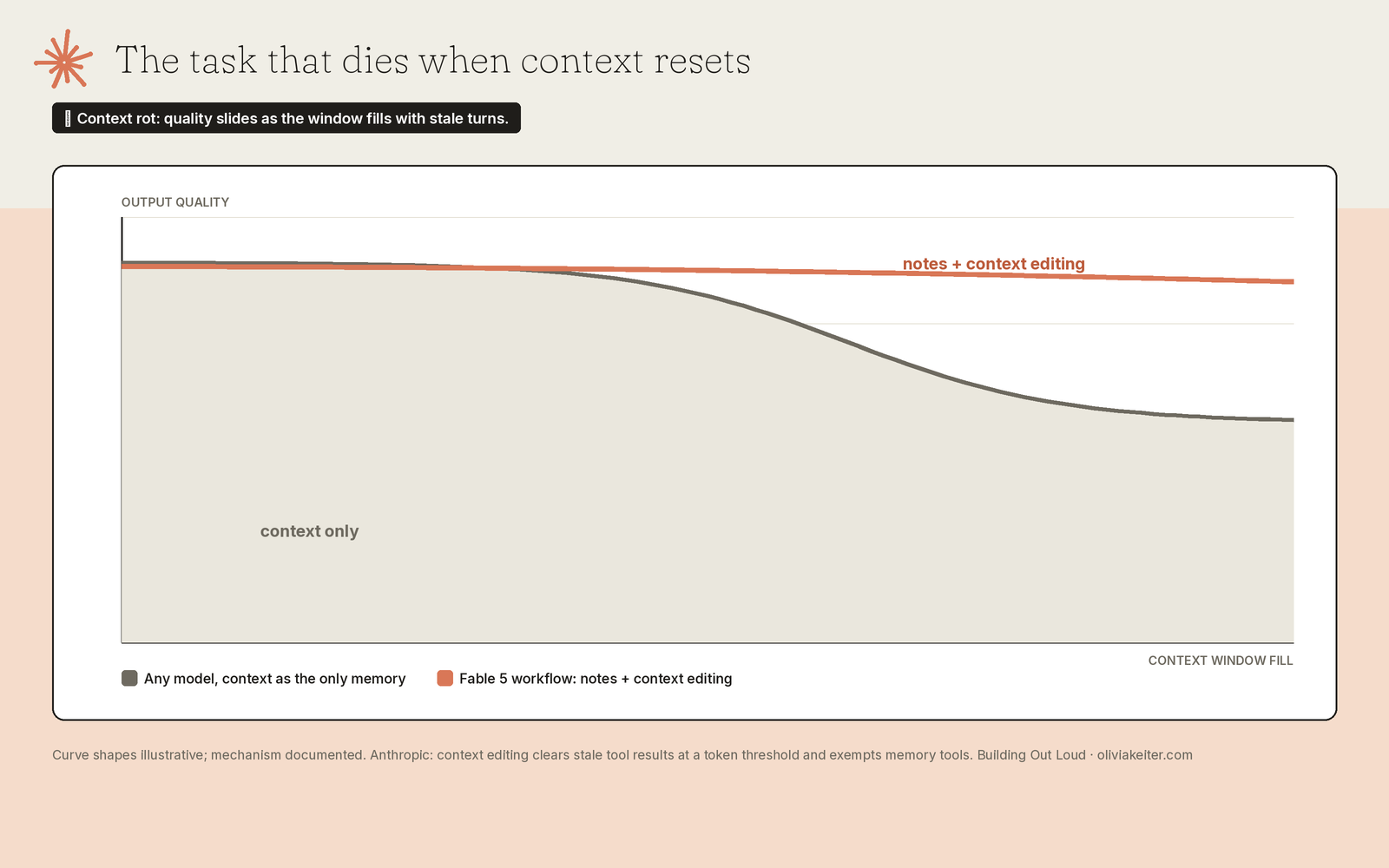
The task that dies when context resets. Curve shapes illustrative; the mechanism is documented.
The numbers, since I promised receipts
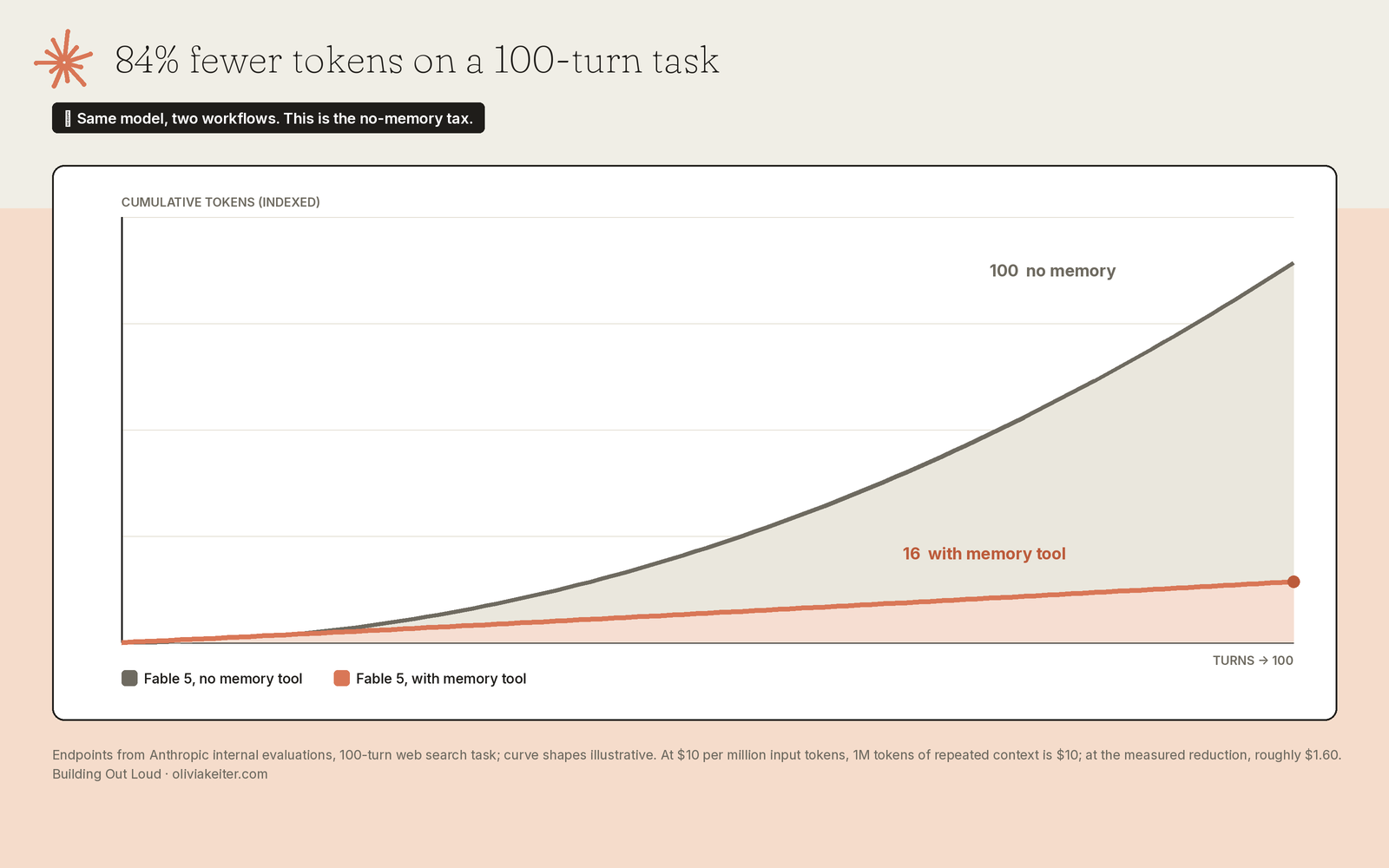
84% fewer tokens on a 100-turn task. Same model, two workflows. Anthropic internal evaluations.
Anthropic’s launch materials put real figures behind the memory story, so here they are, labeled. Their internal evaluations measured 84% fewer tokens consumed on a 100-turn task with the memory tool, and a 39% performance gain over a no-memory baseline. In their Slay the Spire test, persistent file-based memory improved Fable 5’s performance three times more than it improved Opus 4.8. Internal evals, not independent benchmarks, but the direction matches what I feel in daily use.
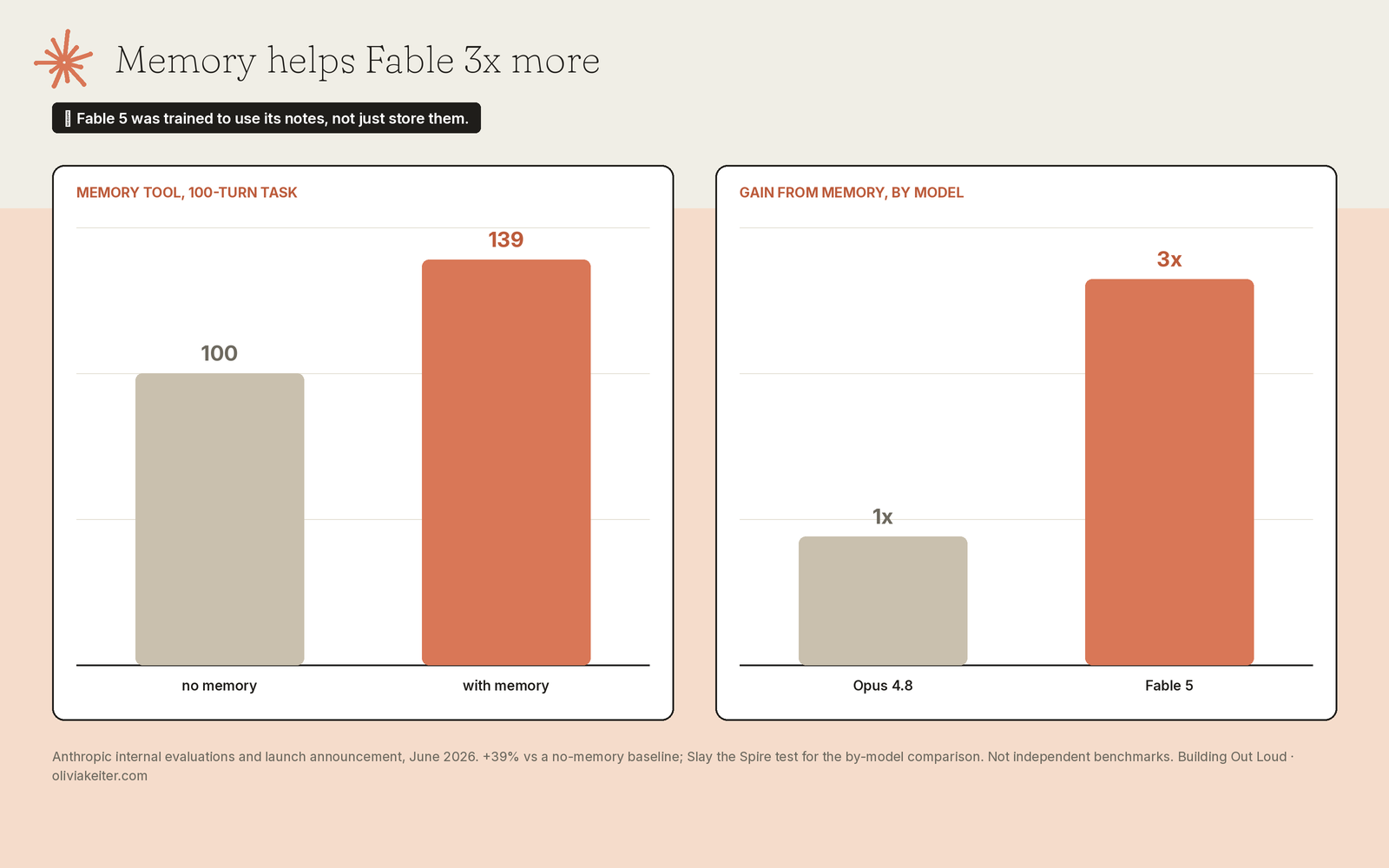
Memory helps Fable 3x more than it helped Opus 4.8. Anthropic internal evaluations, June 2026.
The practical version: if your projects span weeks or months, an AI that doesn’t reset is a different tool. Not a faster version of the old tool. A different one.
The decision I haven’t made
Full honesty, because that’s the whole point of this blog: I haven’t decided if it’s worth the cost when it moves to usage credits after July 7.
Fable 5 runs $10 per million input tokens and $50 per million output through the API, and the consumer side shifts to usage credits after the included window ends. That’s real money. The memory math softens it, since fewer tokens per task means the most expensive model per token can come out cheaper per finished task, but “can” is doing work in that sentence. I’m running the numbers against my own actual workload, the client builds, the job search pipeline, the skill library maintenance, before I commit.
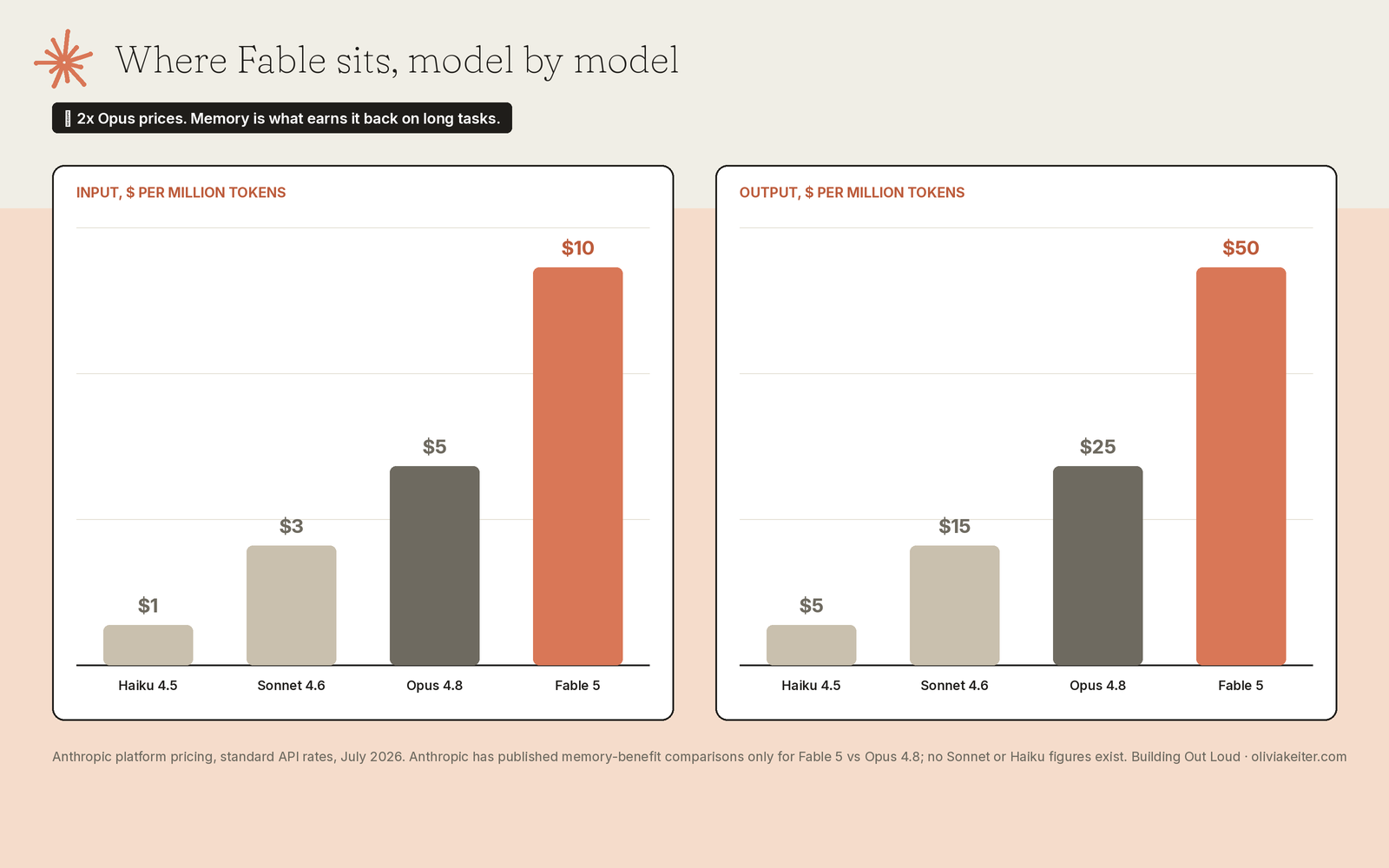
Where Fable sits, model by model. Anthropic standard API rates, July 2026. Memory-benefit data is only published for Fable vs Opus 4.8, so the honest cross-model chart is price.
If you’re weighing the same decision, I put together a carousel with the documented figures, the fine print on classifier reroutes and data retention, and what I’d take into account before moving real work onto this model. It’s on my LinkedIn, and the sources are labeled on every slide.
Either way, do this now
Here’s where I land for anyone reading this while the included access window is still open. Whatever you choose, use Fable or don’t, my advice is the same: use this time to set yourself up for better systems and workflows now, while experimenting is cheap.
Ask it what it’s noticed about how you work. Ask where you’re redoing things that should be repeatable. Build the skill files, write the source-of-truth docs, put your state somewhere durable. Every bit of that work pays off no matter which model you’re running next month.
If you commit to Fable later, you start ahead. If you don’t, you still walk away with better workflows than you had in June. That’s the whole trade, and right now it’s discounted.
Stay in the loop
Get the next entry.
New notes land in your inbox when there is something worth reading. No cadence, no filler.
Powered by Buttondown. One click to unsubscribe, always.